What multi-agent system architecture skills do you need for 2026?
Feb 14, 2026
Introduction:
Well, the single AI agents are dead, and the industries are moving to the multi-agent systems last year. Now every real AI implementation uses multiple specialized agents working together. So you need to understand the multi-agent architecture immediately. This isn't optional anymore.
Well, the job market is not optional anymore. Companies don’t want people who can chat with ChatGPT. They need architects who can design systems where ten or twenty specialized agents coordinate to solve big problems. Your Python with AI Course means nothing if you can't orchestrate agent teams.
Why Single Agents Don't Work:
One agent trying to do everything breaks constantly. An agent handling customer service, data analysis, and task execution makes too many errors. It gets confused. It mixes up contexts. It can't go deep enough in any area.
Multi-agent systems divide work among specialists. One agent plans workflows. Another executes tasks. A third checks outputs. A fourth fixes errors. Each agent masters one thing instead of fumbling through ten things.
Organizations learned this the expensive way through the course. 95% of single-agent pilots crashed before reaching production. The agents were unreliable. They made costly mistakes. They couldn't handle weird situations. Multi-agent setups solve these problems by splitting responsibilities.
What are the Architecture Skills You Must Have?
These are some of the skills that you must have.
Orchestration Design:
You design how agents communicate and coordinate. Which agent decides what? Which agents do the work? How do agents share information? What happens when one agent dies?
Every Machine Learning Online Course should teach orchestration now. Most don't. You need to learn this separately through specialized training or real projects.
Agent Specialization:
Designing agent roles requires breaking down complex work into separate tasks. You split workflows into pieces. You assign each piece to a specialized agent. You define clear boundaries between agents.
An Agentic AI Course teaches this properly. Regular AI courses still focus on building single models. That doesn't cut it anymore.
Communication Protocols:
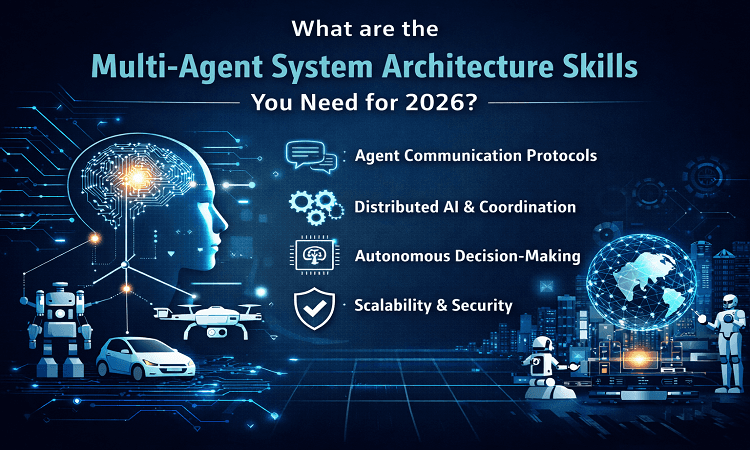
Agents need standard ways to talk with each other. MCP (Model Context Protocol) and A2A (Agent-to-Agent) protocols are becoming the norm. You must understand how agents exchange data, trigger actions in other agents, and handle workflows that don't happen all at once.
There are many Artificial Intelligence Online Course in India that do not include this, so you are not learning outdated material if your course skips inter-agent communication.
Governance and Control:
There are many of the multi agent systems that need to be paid attention to. Which human approves which decisions? When do agents run autonomously, versus when do they need permission? How do you stop agents from making catastrophic mistakes?
There are many of the governance frameworks that are brand new territory. Traditional courses don’t cover this because it did not exist when those courses were created. You need current training that addresses 2026 realities.
State Management Across Agents:
When multiple agents attack the same problem, they need a shared state. Agent A's output feeds Agent B's input. Agent C watches both and jumps in when needed. Managing this complexity requires advanced architectural knowledge.
Cost Optimization:
Running multiple agent’s costs more than running one. You balance quality, speed, and money. Sometimes a small language model beats a large one for specific agent jobs.
Conclusion:
From the above discussion, it can be said that one should apply training that covers the orchestration patterns, agent communication protocols, governance frameworks, and production deployment of multi-agent systems. Theory alone doesn't work. Because you may need practice for building systems where multiple agents coordinate. Organizations building serious AI in 2026 need multi-agent architects.