How Raw Data Becomes Clean Data in Real Projects?
Mar 3, 2026
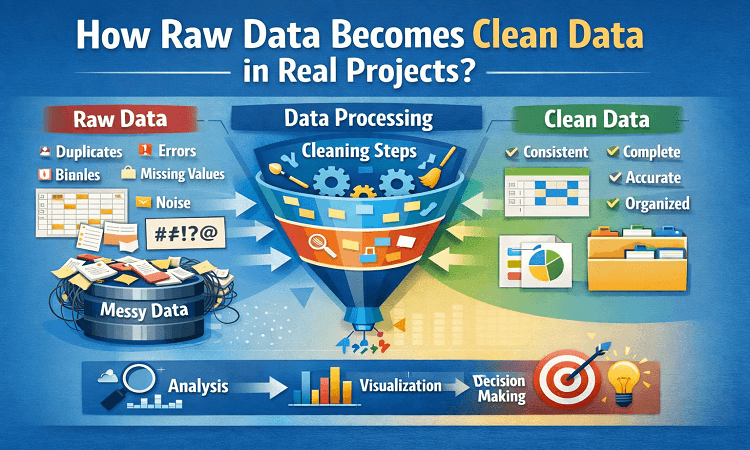
Raw data moves through systems every second. It flows from apps, devices, forms, and services into storage layers. This data is not ready to use. It carries gaps, wrong values, mixed formats, and broken links. Some records repeat. Some arrive late. Some arrive out of order. If this data is used as it is, reports break, models learn wrong patterns, and teams lose trust in numbers. Real projects treat data cleaning as a core system process, not a final step.
This work shapes how reliable every output will be. Many learners who start with dashboards later realize that most effort sits before analysis begins. People who begin with a Data Analyst Course often discover that cleaning and control of raw data take more time than building charts.
How raw data enters systems and where it fails?
Data enters through APIs, event streams, batch files, and logs. Each source brings risks.
Common failure points at entry:
● Fields change names without notice
● Data types change from number to text
● Required fields come empty
● Events repeat
● Events arrive late
● Time stamps use mixed zones
● Files arrive with broken rows
Real systems protect entry points with rules:
● Schema rules to lock field names and types
● Required field rules to block empty keys
● Size limits to stop broken payloads
● Source tags to track origin
● Version tags to track format changes
When rules fail, data is sent to a hold table. The hold table stores records with reasons for failure. This allows fixes without breaking main tables. It also helps teams fix issues at the source system instead of patching data later.
Shaping clean data for reports and models
After cleaning, data is shaped for use. Analytics tables often use wide formats. Feature tables for models use time-aware joins.
Key shaping rules:
● Use stable keys for joins
● Lock feature logic with versions
● Avoid future data leaking into past rows
● Store time windows clearly
● Handle late data with safe backfills
Backfills are part of real work. When rules change, past data must be rebuilt. Real pipelines support safe backfills. They write data in parts. They track job versions. They avoid double writes. This allows teams to fix history without breaking current results.
Design choices that affect data cleaning
Pipeline design shapes how cleaning works.
Key trade-offs:
● Batch pipelines allow deep checks but are slow
● Streams are fast but allow fewer checks
● Hybrid designs balance speed and depth
● Column storage speeds reads
● Row storage speeds writes
● Partitioning cuts scan cost
● Indexes speed joins but slow writes
Metadata helps manage quality. Datasets carry owners, freshness targets, and quality scores. Dashboards show data health trends. When quality drops, teams act before users lose trust.
Better models come from better features. Better features come from clean pipelines. Many learners in a Data Science Course see that model gains often come from fixing data issues, not from changing algorithms.
Local tech pressure and data quality work
In Bengaluru, fast product teams ship features often. Event formats change often. Logs grow fast. This creates noise and drift. Teams respond by using strict data contracts and shared rule libraries. Entry checks block broken events. Lineage tools track field changes. This allows fast product work without breaking trust in metrics.
The local job market also values people who can own pipelines end to end. Teams build reusable checks and shared cleaning rules to keep speed without losing data quality.
Formal learning paths like a Data Analytics Certification Course test how well learners design checks, manage drift, and run backfills safely, not just how they write queries.
Table: Common production cleaning rules
Area | What is checked | How it is enforced | Why it matters |
Schema | Field names and types | Schema rules and versioning | Stops silent breaks |
Completeness | Required fields not empty | Null rate checks | Protects joins and metrics |
Uniqueness | Keys not repeated | Duplicate checks | Avoids double counts |
Valid ranges | Values within limits | Range rules | Catches input errors |
Freshness | Data arrives on time | Time checks | Keeps daily numbers right |
Referential links | Keys match parent tables | Join checks and hold tables | Protects table links |
Deduplication | Events not repeated | Hash and ID rules | Keeps totals clean |
Time correctness | Events in right windows | Filters and watermarks | Prevents leakage |
Teams planning advanced paths like Masters in Data Analytics benefit from treating cleaning as system design work. Rules are versioned. Tests are tracked. Costs are planned. Backfills are controlled.
Key takeaways
● Raw data is always messy
● Cleaning must be part of the system
● Entry checks stop bad data early
● Schema drift must be managed
● Automated checks prevent silent errors
● Lineage and logs speed up fixes
● Backfills must be safe
● Feature quality depends on clean pipelines
● Design choices affect trust
● Data quality must be tracked
Sum up,
Raw data becomes clean data only when teams design pipelines that expect errors and change. Cleaning is built from rules, checks, logs, and controlled reruns. Real projects work when data quality is treated as system design, not a side task. When entry points are protected, rules are tested, and history can be rebuilt safely, teams trust their reports and models. This trust allows faster work, better decisions, and fewer late fixes. Clean data is not about neat tables. It is about building systems that keep meaning safe as data moves through many layers.