How AI Agents Make Decisions Without Human Instructions?
Mar 17, 2026
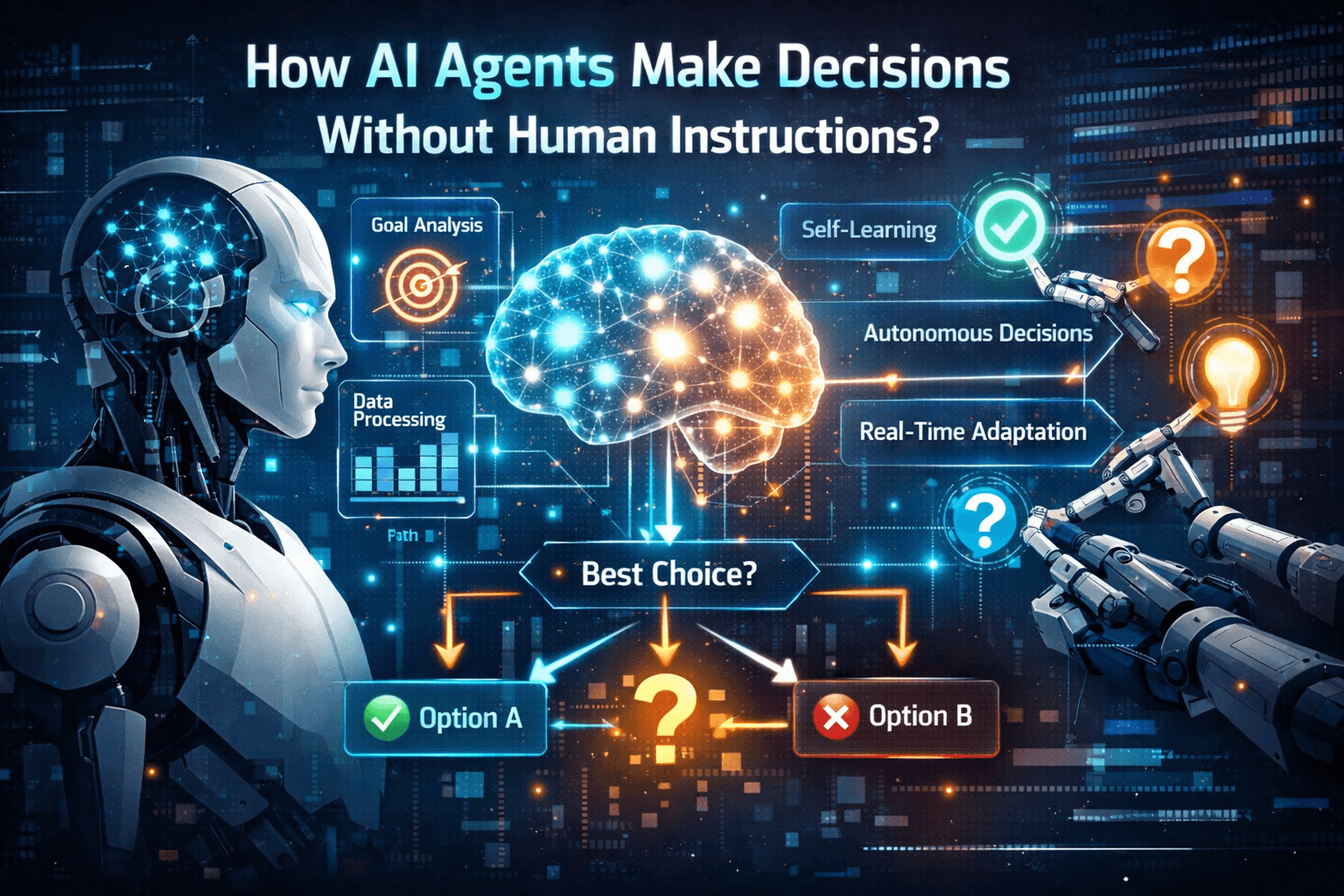
Recently, artificial intelligence has developed beyond mere automation. Currently, artificial intelligence systems have the ability to analyze their surroundings, make decisions, and improve those decisions without having to wait for human response. This is perceived to be the foundation of modern artificial intelligence systems, and it is one of the advanced subjects that are covered in an Agentic AI Course. Rather than simply responding to commands, artificial intelligence systems have their own logic for accomplishing tasks and their own decision-making systems.
The Architecture Behind Autonomous AI Decision Systems
However, at the core of agent-based intelligence, there is a structured architecture that dictates how the agent thinks and behaves. Most artificial intelligence agents make use of a loop-based reasoning model, which is described by the perception–decision–action cycle.
Components of the cycle:
• Perception Layer – receives information from the environment, such as data streams, sensors, APIs, and databases.
• Memory System – stores information from previous interactions and experiences.
• Reasoning Engine – interprets information using machine learning algorithms and techniques.
• Action Module – carries out actions based on the decisions made by the reasoning engine.
• Feedback Loop – measures the outcome and adjusts the strategy accordingly.
Components of an AI agent are expected to be evaluated in an Agentic AI Course while it interacts with its real-world environment. The process of decision-making not only depends upon the information it receives but also upon the goal and what is logically appropriate with respect to it.
Planning Algorithms That Help AI Agents Decide
The most technical process of decision-making in AI is the planning system. AI systems do not take decisions randomly. There are various algorithms used in the decision planning process:
Algorithm Type | How It Helps AI Agents Make Decisions |
Reinforcement Learning | AI learns by trial and error and improves its decisions based on rewards or penalties |
Decision Trees | Breaks down possible choices and outcomes to identify the best action |
Monte Carlo Simulations | Runs multiple scenario simulations to predict outcomes |
Goal-Oriented Action Planning (GOAP) | Helps agents plan sequences of actions to achieve a defined objective |
Bayesian Decision Models | Uses probability to evaluate uncertain outcomes |
These algorithms enable AI agents to function even in uncertain situations.
For example, sophisticated technical modules within an Artificial Intelligence Online Course might examine the relation between such algorithms and large language models.
For example, a data analysis AI agent might receive a goal such as “extract sales trends from last year.” Without adhering to each command in sequence, the AI agent might:
• retrieve relevant data sets
• preprocess data sets
• execute data analysis models
• create graphical reports
• offer business insights
All this is done automatically since the AI agent is aware of the goal and acts accordingly.
Role of Memory and Context in Autonomous AI Decisions
One of the key differences between simple automation and intelligent AI systems is the idea of context awareness.
Simple automation programs forget the context of interactions once they are over. On the other hand, AI systems have their own memory systems, which allow them to remember their long-term goals and their past experiences.
The memory system of AI systems can be divided into three types:
Short-term memory: The temporary information regarding the recent tasks or commands given to the AI systems is stored in this type of memory.
Long-term memory: Past interactions, data, and decision patterns are stored in this memory.
Vector memory systems: Knowledge is stored in a numerical form using embeddings to allow AI systems to easily retrieve relevant information.
These memory systems allow AI systems to make decisions that are consistent with past behavior.
Without memory systems, AI systems would be no different from simple chatbots. With memory systems, AI systems can be decision-making systems capable of managing complex workflows.
Real-World Development Trends in AI Agent Systems:
Cities with robust technology infrastructures are being used as testing environments for autonomous AI systems.
In Gurgaon, there are various enterprise technology firms using AI agent technology to develop automation for financial activities and data analysis. There has been an increased demand for AI professionals in Gurgaon due to the exploration of AI agent technology for automation in fintech and logistics.
Learning environments such as an Artificial Intelligence Online Course provide simulated environments similar to real-world enterprise scenarios where AI systems are being used.
Multi-Agent Collaboration and Distributed Decision Making:
While one AI agent can perform tasks on its own, complex AI systems consist of many AI agents working in unison.
In complex AI systems, different AI agents are used for different tasks.
For example:
• There is an AI agent that handles data
• There is an AI agent that handles planning
• There is an AI agent that handles execution
• There is an AI agent that handles monitoring
Such complex AI systems allow the AI system to overcome complex tasks faster.
Another major aspect of discussion in a Python with AI Course revolves around the communication between different AI agents of the AI system, which are based on shared memory systems and message passing architectures.
Sum up,
AI agents represent a paradigm shift in the functioning of artificial intelligence systems. These systems do not have to wait for instructions but instead assess goals, plan, and act independently. The ability to make decisions is accomplished by a structured architecture, planning, memory, and feedback. As organizations adopt self-managing digital operations, the need to understand agent-based frameworks in AI is on the rise.